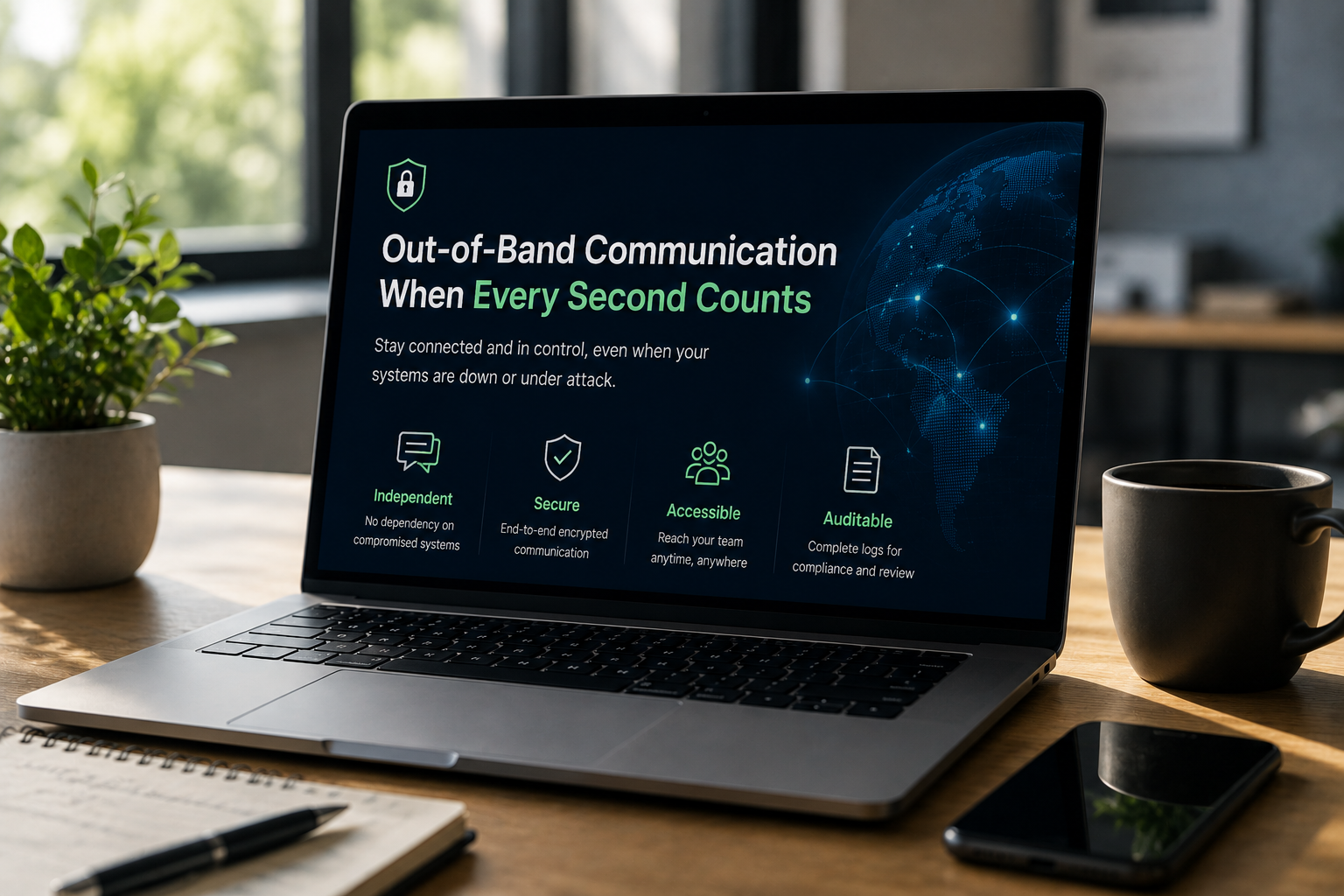
What Is Out-of-Band Communication? And Why Your Incident Response Plan Needs It
Out of band communication in incident response means coordinating over a channel that does not depend on the systems, identity provider, or network currently under investigation. The phrase "out of band" appears in several other contexts (console management access, telecoms signalling, multi factor authentication over a separate channel), but this article is about one thing only: how incident response teams communicate when their normal tools are compromised, observed, or offline.
If you own the incident response plan, this is the piece that determines whether your fallback actually works.
Out-of-band communication in incident response: working definition
Out-of-band communication is any backup communication channel used during incident response that operates independently from primary IT systems under investigation.
Unlike in-band communication, which uses the same pathway for primary data traffic, an out-of-band channel has no dependency on the compromised identity provider, corporate network, or collaboration workspace.
The test is dependency, not encryption. If the channel still works when your SSO is down, your email is in scope, and your chat workspace is potentially observed, it qualifies as out of band.
The dependency test is straightforward. A channel only counts if it remains usable when your SSO, corporate email, and normal chat workspace are all either in scope of the incident or offline. If the channel shares login through the same identity provider, or routes through the compromised infrastructure, it is still in band, regardless of whether messages are encrypted.
Two non-examples make this concrete.
- An encrypted messaging app such as Signal or WhatsApp where your team authenticates using corporate SSO. The messages may be end-to-end encrypted, but if the identity provider is compromised, the attacker controls who can log in. That is not out of band.
- A "backup" Microsoft Teams tenant that federates to the same Azure AD. If your IdP is breached or simply offline, that backup tenant is inaccessible. It shares the same trust boundary.
OOB communication can operate independently of primary IT systems, and that independence is what gives it value. It is one layer in the wider incident response plan, not a replacement for Slack, Teams, or your SIEM.
It supports business continuity and organizational resilience by ensuring continuity of coordination when everything else is in question.
In practice, FieldSignal and Zetako work with incident response leads, SOC managers, and strategy teams who often discover during tabletop exercises that their supposed "fallback" channel is still tied to the same trust boundary they are investigating.
The gap is usually not the absence of a plan. It is that the plan has never been tested against realistic failure conditions.
Why your incident response plan needs out-of-band communications
Most incident response plans name the primary communication channel. Fewer name the backup. Almost none have tested it.
If you are the person who would be asked why the team could not coordinate during a major incident, this section is for you.
There are three core reasons emergency incident responses benefit from out-of-band communication channels, and they are independent of each other.
Availability
Primary tools go down. An IdP outage can lock the entire team out of email, chat, and ticketing simultaneously.
Containment actions during ransomware response, disconnecting VPNs, shutting down directory services, frequently break the team's own communication stack as a side effect.
Organizations can lose $5 million per hour during downtime, and that figure includes the cost of teams unable to coordinate, not just systems unable to serve customers.
Out-of-band channels allow teams to communicate during system outages, which is the baseline reason to have one.
Observation
This is the strongest argument, and it is documented.
CISA's #StopRansomware Guide states that after an initial compromise, threat actors may monitor an organisation's activity or communications to understand whether they have been detected.
CISA recommends out-of-band methods such as phone calls when isolating systems, specifically to avoid tipping off the attacker.
Out-of-band communication enhances security by creating a separate channel the adversary cannot see. If your incident response communication plan runs through a workspace the attacker is watching, your containment plans are not secret.
Defensibility
After the incident, regulators, courts, and insurers will examine what decisions were made, by whom, and when.
Communications that ran through compromised channels may have altered logs or be attributable to compromised accounts. A preserved record from a separate channel is more credible.
Out-of-band communication is important for cybersecurity applications precisely because it provides this kind of evidentiary independence.
NIST SP 800-61r3, finalised in April 2025, aligns incident response with CSF 2.0 and emphasises that incident response plans must assume system and tool failure. It requires documented, tested procedures for communication even when the usual tools are compromised.
The more prescriptive operational language still comes from SP 800-61r2, but the principle is the same: plan for the tools to fail.
Public companies face SEC 8-K timelines that require timely disclosure of material events. EU entities under NIS2 and DORA must report significant incidents within tight windows and are expected to maintain coordination capacity during disruption.
If leadership cannot communicate securely to make those decisions, the organisation risks both the incident and the regulatory fallout.
One more thing worth stating plainly. Improvised WhatsApp or Signal groups created in the middle of a ransomware response are better than nothing.
But they routinely fail on roster control, participant verification, retention, and legal privilege. They are a crisis reaction, not a plan.
Out-of-band communication enhances incident response during cyberattacks only if the channel was provisioned, tested, and maintained before the event.
A planned out-of-band channel belongs in the same category as EDR, forensics retainers, and external counsel: tools you set up before you need them, as part of modern cyber crisis management.
When your normal channels fail or cannot be trusted
Email, chat, and ticketing rarely all fail at the same moment. But any single dependency can make regular communication channels unreliable or unsafe.
These are independent failure modes. They do not follow a fixed sequence. Some incidents take out one, some take out several, and sometimes the problem is trust rather than availability.
Identity provider or SSO disruption
When an IdP like Okta or Azure AD goes down or is compromised, everything federated behind it disappears: email, Slack or Teams, on-call tools, even the wiki where the IR runbook lives.
The SOC scrambles for any working login. If the out-of-band channel also depends on that same SSO, it fails at the exact moment it is needed.
Out-of-band channels remain operational during cyber incidents and outages only if they authenticate independently.
Mailbox access as part of the incident
In January 2024, Microsoft disclosed that the threat actor Midnight Blizzard had accessed mailboxes belonging to senior leadership, cybersecurity, and legal functions.
Coordinating incident response over corporate email during that period would have meant communicating through a channel the attacker could read.
This is not a hypothetical scenario. It is documented.
Out-of-band communication ensures operations during IT outages and, more critically, during active compromise of the communication layer itself.
Collaboration workspace in scope
Even if Slack or Teams is technically up, it may sit inside the blast radius being investigated.
An attacker with session tokens or administrative access could read investigation channels, spot containment plans, or map the response team's priorities.
This is precisely where CISA's guidance on out-of-band communications applies. Out-of-band channels are used for emergency commands and troubleshooting when the primary workspace cannot be trusted.
Ransomware and deliberate containment
Ransomware attacks can be mitigated using out-of-band channels during incidents because the containment process itself often destroys communication.
Encrypting or disconnecting file shares, directory services, and VPNs during ransomware response breaks the team's own comms as a side effect.
A global media company lost $100,000 per minute during an outage partly because coordination collapsed alongside infrastructure.
An untested fallback becomes a serious business continuity gap when the team that needs to respond cannot reach each other.
Individual account compromise and impersonation risk
A single compromised SSO account can let an attacker lurk in an IR war room, read every update, and even post misleading information.
Independent authentication and a verified roster in an out-of-band workspace reduce this impersonation risk.
OOB communication ensures collaboration during network outages and, just as importantly, during identity compromises where the question is not whether the tool works but whether the person in the channel is who they claim to be.
Connectivity and mobile assumptions
Phone calls and SMS are common fallbacks, but analog communication methods can serve as out-of-band communication only if you trust the carrier and the endpoint.
CISA's December 2024 Mobile Communications Best Practice Guidance was published in direct response to espionage campaigns targeting telecommunications infrastructure.
It warns that SMS messages are not encrypted and recommends moving away from SMS-based MFA for sensitive communication.
Decentralized networks maintain communication during global service disruptions, but only if you have provisioned them.
Similarly, a third-party or cloud provider outage affecting the collaboration platform or IdP can leave teams without any working channel if the fallback shares the same provider.
Out-of-band vs in-band communication: practical comparison
The distinction between out of band vs in band for incident response is not about which tools are better day-to-day.
Both types of channel are needed. In-band tools handle normal operations. Separate communication channels handle the scenarios where normal operations are in scope.
The comparison below contrasts typical in-band tools such as corporate email, Slack or Teams, and on-call platforms behind SSO with the criteria for a genuine out-of-band channel.
- Dependency on corporate identity: In-band communication authenticates via the primary IdP or SSO. Out-of-band communication uses separate, pre-provisioned credentials.
- Dependency on corporate network and devices: In-band communication may require VPN, managed devices, or the corporate network. An out-of-band channel should be reachable from personal devices, mobile networks, or the internet.
- Who can read it: In-band communication may be accessible to anyone with access to the compromised environment, potentially including the attacker. An out-of-band channel is limited to a verified roster outside the attacker's observed boundary.
- Who can join it: In-band communication is controlled by the same directory under investigation. An out-of-band channel is controlled by a separate administrator, allowing external stakeholders to be added without an SSO dependency.
- Behaviour during containment: In-band communication often breaks as a side effect of isolation actions. An independent out-of-band channel can remain active during cyber attacks or outages.
- Record and retention: In-band logs may sit inside compromised systems, making their integrity uncertain. Out-of-band logs are stored outside the affected environment, providing a clearer chain of custody.
- Ease of adding external parties: External counsel, forensics teams, and insurers may require guest accounts on the corporate tenant with in-band communication. With an out-of-band channel, external parties can join using independent credentials with granular access control.
- Legal and regulatory handling: In-band records may be subject to tampering claims and can make integrity difficult to prove. A separate out-of-band record can support legal compliance, privilege claims, and audit defensibility.
End-to-end encryption alone does not make a channel out of band.
If the identity provider, network path, or admin control are shared with the compromised environment, the encryption protects the content but not the access.
Out-of-band channels enhance security against network threats because they sit outside that shared trust boundary entirely.
Once the incident is closed, key decisions, logs, and summaries from the out-of-band channel can be fed back into central systems to preserve a defensible and discoverable record for regulators, courts, and insurers.
The separation is temporary and tactical, not permanent.
What makes an out-of-band communication channel effective
Many teams already have something they call out of band. It fails under pressure because it was never provisioned, verified, or tested.
Here is what actually works.
Independent authentication
Accounts must not rely on the primary identity provider or corporate SSO.
Pre-provisioned credentials or break-glass identities should be issued and stored in advance for responders and executives.
Multi factor authentication often uses out-of-band communication for security, and the same principle applies here: the authentication path for your fallback channel must be genuinely separate.
Physical token delivery improves security by avoiding digital transmission of credentials through potentially compromised systems.
Separate infrastructure and administrative control
The out-of-band channel should run on infrastructure with a different blast radius from production.
Whether self hosted in a separate enclave or hosted by a provider with independent access control, the point is to limit shared failure modes.
If the same cloud account, the same admin credentials, or the same network segment controls both your production workspace and your fallback, you have one channel, not two.
Pre-provisioned and pre-tested
Accounts, groups, and basic channels must exist before an incident.
Joining for the first time during ransomware containment is a sign the plan will fail.
Independent communication channels are necessary for secure operations, but only if people can actually log in under stress.
Use tabletop exercises to verify this at least annually.
Verified roster and identity checks
Maintain a list of who should be in the out-of-band workspace.
Have a simple verification procedure for new joiners, such as a pre-shared code, a voice callback, or a known contact confirming identity.
During high-pressure events, impersonation risk rises. A verified roster is the difference between a war room and an open door.
Device independence and access without the corporate network
Responders need to reach the out-of-band channel if the VPN, office LAN, or standard laptops are offline.
That usually means the channel must be easily accessible from personal devices over the internet.
This creates a trade-off: personal devices may be subject to legal discovery, and your acceptable use policy needs to address this.
Make the decision in advance, not during the incident.
Retention, logging, and legal handling
Incident communications may later sit under legal privilege or discovery.
Retention settings, export options, and where the data resides all matter for legal compliance and data sovereignty.
The channel should support preserving sensitive information in a way that is exportable, tamper-evident, and stored in a location your legal team has approved.
Capacity for external parties
Counsel, forensics providers, insurers, regulators, and key partners should be able to join without requiring SSO credentials from your compromised tenant.
Granular access control lets each party see only what they need.
Forgetting external stakeholders until the moment they are needed is one of the most common planning failures.
Usable under pressure
Dynamic OOB platforms streamline incident response and coordination, but only if the interface is familiar.
Security engineers, SOC analysts, executives, and third parties all need to operate the tool when tired and stressed, even if they log in only during incidents or scheduled exercises.
Complexity is the enemy of crisis communication.
FieldSignal works with clients testing these criteria during expert interviews, war-gaming, and incident response strategy projects, helping teams benchmark their current OOB communications approach against peers in similar industries.
Building out-of-band communications into your incident response plan
At this point the need for an alternate communication channel should be clear.
The question is how to embed it into the written incident response plan and crisis communication process so it actually works on the day.
Document where the channel details live
The out-of-band workspace credentials, access URLs, and contact lists must be stored somewhere that does not depend on the systems likely to be affected.
If the only copy of your fallback instructions is on the intranet, the wiki, or a shared drive behind the same IdP, you have stored your plan inside the failure.
Printed copies, secure offline storage, or a separate, low-dependency location are all valid options.
Define clear triggers
Specify which scenarios require switching to out-of-band communication:
- Suspected compromise of the identity provider.
- Confirmed mailbox access by an unauthorised party.
- Ransomware containment phases.
- Any situation where the incident commander or on-call SOC lead judges that in-band channels cannot be trusted.
The authority to declare the switch should be explicit in the plan.
Assign ownership
Someone must own the roster.
That means reviewing access when people leave or join the organisation, verifying that executives, SOC engineers, and key vendors still have working credentials, and updating contact lists quarterly.
Out-of-band communication is widely used in industries requiring uninterrupted communication, but only where someone is responsible for keeping it current.
Hold a pre-incident contact list outside affected systems
Phone numbers, out-of-band access instructions, and escalation contacts should exist on paper or in secure offline storage.
If the phone numbers are in the directory that is down, the fallback does not start.
Integrate into tabletop exercises
Teams should actively practise the handover from in-band to out-of-band during ransomware simulations and cyber crisis management exercises.
Facilitators should introduce realistic failures: SSO outage, chat workspace compromise, or a simulated compromised executive account.
The exercise should confirm that relevant stakeholders, including external counsel and forensics providers, can reach the out-of-band channel within an acceptable time.
Out-of-band communication checklist
Use this checklist to assess your current fallback channel in an afternoon and update your incident response communication plan accordingly.
Each item is a yes-or-no question.
- [ ] The out-of-band channel authenticates independently from the primary identity provider and corporate SSO.
- [ ] The channel runs on separate infrastructure with independent administrative control from the production environment.
- [ ] Accounts for all core responders, executives, and key stakeholders are pre-provisioned and credentials are stored securely outside affected systems.
- [ ] Triggers for switching to the out-of-band channel are documented in the incident response plan, with named authority to declare the switch.
- [ ] A verified roster exists, listing who should be in the workspace, with a procedure to confirm identity of new joiners.
- [ ] A pre-incident contact list including phone numbers and access instructions is held offline or in a location independent of the primary network.
- [ ] Every person on the roster has tested their login within the past six months.
- [ ] External parties such as legal counsel, forensics providers, insurers, and relevant parties have been onboarded and can access the channel without corporate SSO.
- [ ] Retention and export settings have been reviewed by legal for compliance with regulatory and insurance requirements.
- [ ] The out-of-band channel is included in tabletop exercises at least annually, with realistic failure scenarios.
- [ ] Executives and the board know which alternate communication channel to expect during a major incident and have tested access.
- [ ] For teams with data sovereignty obligations, including EU public sector, defence, and regulated financial services, the deployment model — self-hosted or hosted with confirmed data residency — meets data protection requirements.
Security, data control, and regulatory considerations
An out-of-band channel still sits inside your risk and compliance perimeter.
It handles sensitive data during the most critical moments of an incident, so it needs the same disciplined treatment as any other critical system.
Baseline security
End-to-end encryption protects sensitive communications from interception.
Authentication should avoid SMS where possible, consistent with CISA's 2024 mobile guidance.
Access control should be granular, and logging should be sufficient for incident communication without creating an unnecessary attack surface.
ISO 27001 certification ensures compliance and security for communication systems, and platforms like Teamwire that comply with GDPR and ISO 27001 standards demonstrate one benchmark for this.
Air-gapped data transfers prevent remote malware exfiltration by using physical media, which may be relevant for the most sensitive environments or classified discussions.
Data control
Where data is stored geographically, who administers the platform, and what happens to the incident record after the event all matter.
For financial services, EU public sector, NGOs, or defence customers, data residency and data sovereignty are not optional considerations.
Self hosted chat deployments or hosted options with confirmed data location give security teams the control they need.
Organizations can lose $4.45 million per data breach, and losing control of incident communications during a breach compounds that exposure.
Regulatory framing
NIS2 (Article 21) requires essential and important entities to implement risk-management and incident-handling measures including secure communications.
DORA assumes financial institutions can maintain ICT communication and meet incident reporting obligations during disruption.
Neither prescribes a specific tool, but both assume the capability exists.
An out-of-band communication plan supports legal compliance with these obligations without being explicitly mandated as a named technology.
Legal handling
Incident communications may be subject to legal privilege, regulatory review, or insurance claims.
Preserving chat, notes, and decisions in a way that supports chain of custody, while remaining discoverable and exportable for courts or regulators, is a design requirement, not an afterthought.
Dynamic OOB platforms store processes if systems are compromised, providing a separate, defensible record of what was decided and by whom.
Where ZNode fits in your out-of-band communication strategy
ZNode is a secure, resilient communication layer built for incident response.
It can be deployed outside the primary identity and infrastructure dependency chain, sitting alongside existing tools like Slack, Teams, or your SIEM rather than replacing them.
For incident response teams, SOC analysts, executives, and external partners, ZNode can be stood up in advance with options for hosted or self-hosted deployment.
Security and risk teams can align the deployment with internal policies on data residency and administrative control, which matters for regulated industries, EU public sector, and defence environments.
During major incidents, ZNode supports multi-party coordination: external counsel, forensic firms, insurers, and affected partners can join without depending on your corporate IdP.
Incident communication stays separate from day-to-day collaboration channels that might be in scope of the investigation.
ZNode is designed to remain reachable during containment actions that affect identity providers or corporate networks, assuming the organisation has planned connectivity appropriately.
No system is immune to failure, including ZNode.
Out-of-band communication increases organizational resilience during crises, but layered communication strategies are always preferable to single points of dependency.
Confirm any specific features, certifications, or uptime commitments directly with Zetako before formalising them in your procedures or policy documents.
Testing your out-of-band channel before you need it
An untested out-of-band channel is almost as risky as not having one.
The only convincing proof that it works is to use it in a realistic exercise.
Integrate the out-of-band workspace into regular tabletop exercises and cyber crisis simulations.
Force responders to authenticate using their pre-provisioned accounts. Simulate IdP or email outages mid-exercise. Involve legal, communications, and external partners.
OOB systems should be exercised, not just documented.
After each exercise, capture simple metrics:
- How long it took for the core team to assemble in the out-of-band channel.
- How many failed logins occurred.
- Whether there was confusion over which channel to use.
Feed those findings back into the incident response plan.
An OOB solution only proves its value when it has been tested under conditions that approximate reality.
Out-of-band communication is an achievable, concrete improvement you can act on this week.
Review your current fallback against the checklist above, schedule a tabletop exercise that forces the switch, and close the gap between having a plan and having a plan that works.
Explore ZNode or FieldSignal resources for deeper guidance on incident communication, ransomware response, and organisational resilience.